Watch first
MyGCSEScience · AQA Chemistry
Electrolysis — watch on MyGCSEScience
↗
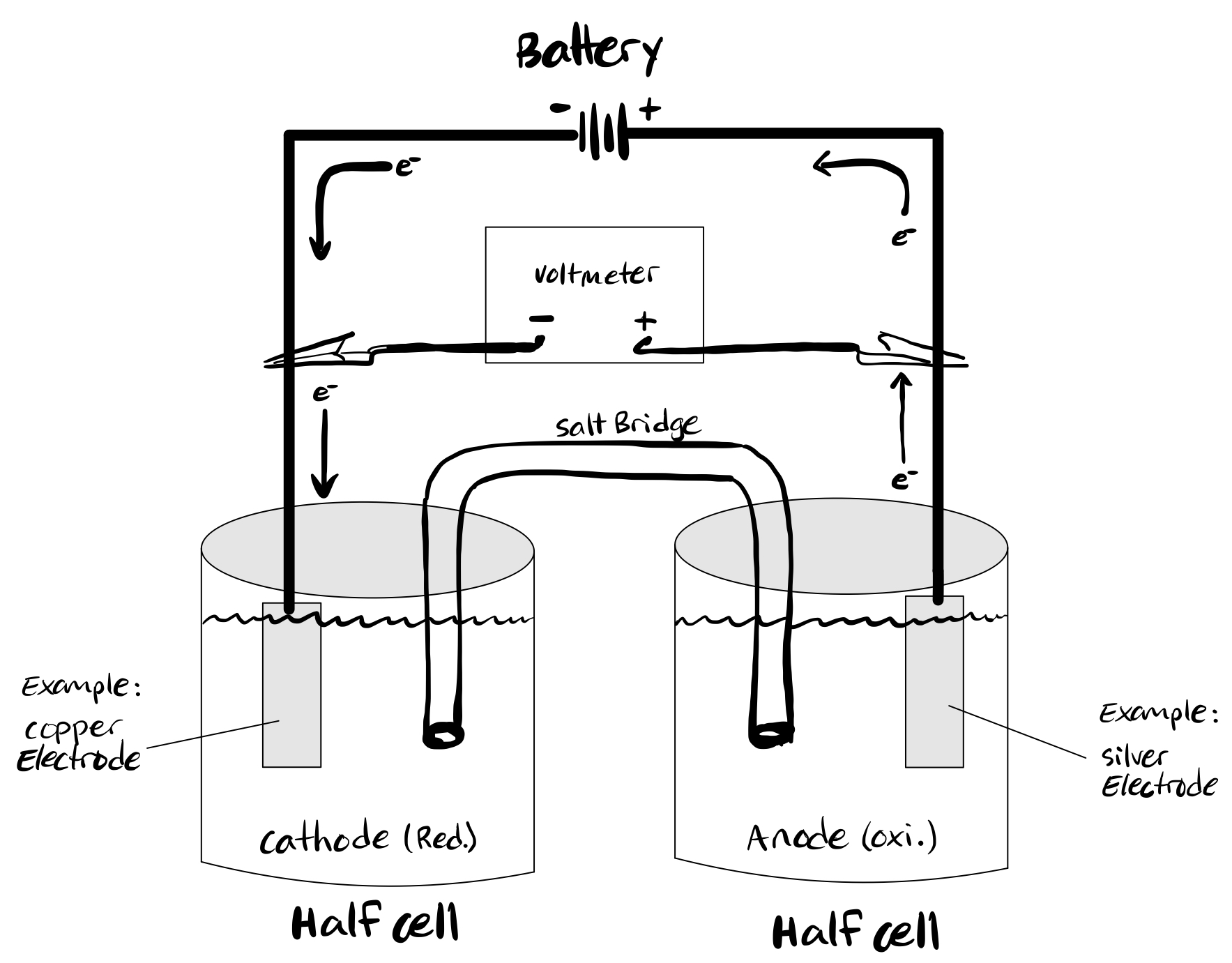
Key facts
Key definitions — fill in the table
| Term | Definition |
|---|---|
| Electrolysis | |
| Electrolyte | |
| Cathode (–) | |
| Anode (+) | |
| OILRIG | |
| OA CA |
Products of electrolysis — fill in the table
| Scenario | Products |
|---|---|
| Molten ionic compounds | |
| Aqueous solutions (general) | |
| At cathode | |
| At anode | |
| Aqueous sodium sulfate (no halide ions) | |
| Aqueous NaCl (brine) |
Half equations — how to write them
- At cathode (reduction): Cu²⁺ + 2e⁻ → Cu or 2H⁺ + 2e⁻ → H₂
- At anode (oxidation): 2Cl⁻ → Cl₂ + 2e⁻ or 4OH⁻ → 2H₂O + O₂ + 4e⁻
- Check: charges must balance on both sides.
- Electrolysis of brine half equations: Cathode: 2H⁺ + 2e⁻ → H₂. Anode: 2Cl⁻ → Cl₂ + 2e⁻
- Uses of electrolysis products of brine: H₂ → fuel/margarine production. Cl₂ → disinfectants/PVC. NaOH → soap/paper.
Exam questions — 4 questions · 10 marks
Copper sulfate solution is electrolysed using inert (graphite) electrodes. What is produced at the cathode?
What are the three useful products of the electrolysis of concentrated sodium chloride solution (brine)?
Write the half equations for the reactions at the cathode and anode during the electrolysis of concentrated brine. State what is produced at each electrode. (4 marks)
Hint: OILRIG: cathode = reduction = gain electrons. Anode = oxidation = lose electrons. H⁺ ions at the cathode; Cl⁻ ions at the anode (a halide, so the halogen is produced).
+40 XP
Aqueous sodium chloride and aqueous sodium sulfate are electrolysed separately using inert electrodes. Explain why different gases are produced at the anode but the same gas is produced at the cathode. (4 marks)
Hint: AQA rule: at the anode oxygen is produced unless the solution contains halide ions, in which case the halogen is produced. At the cathode hydrogen is produced if the metal is more reactive than hydrogen.
+40 XP
Quick recall flashcards